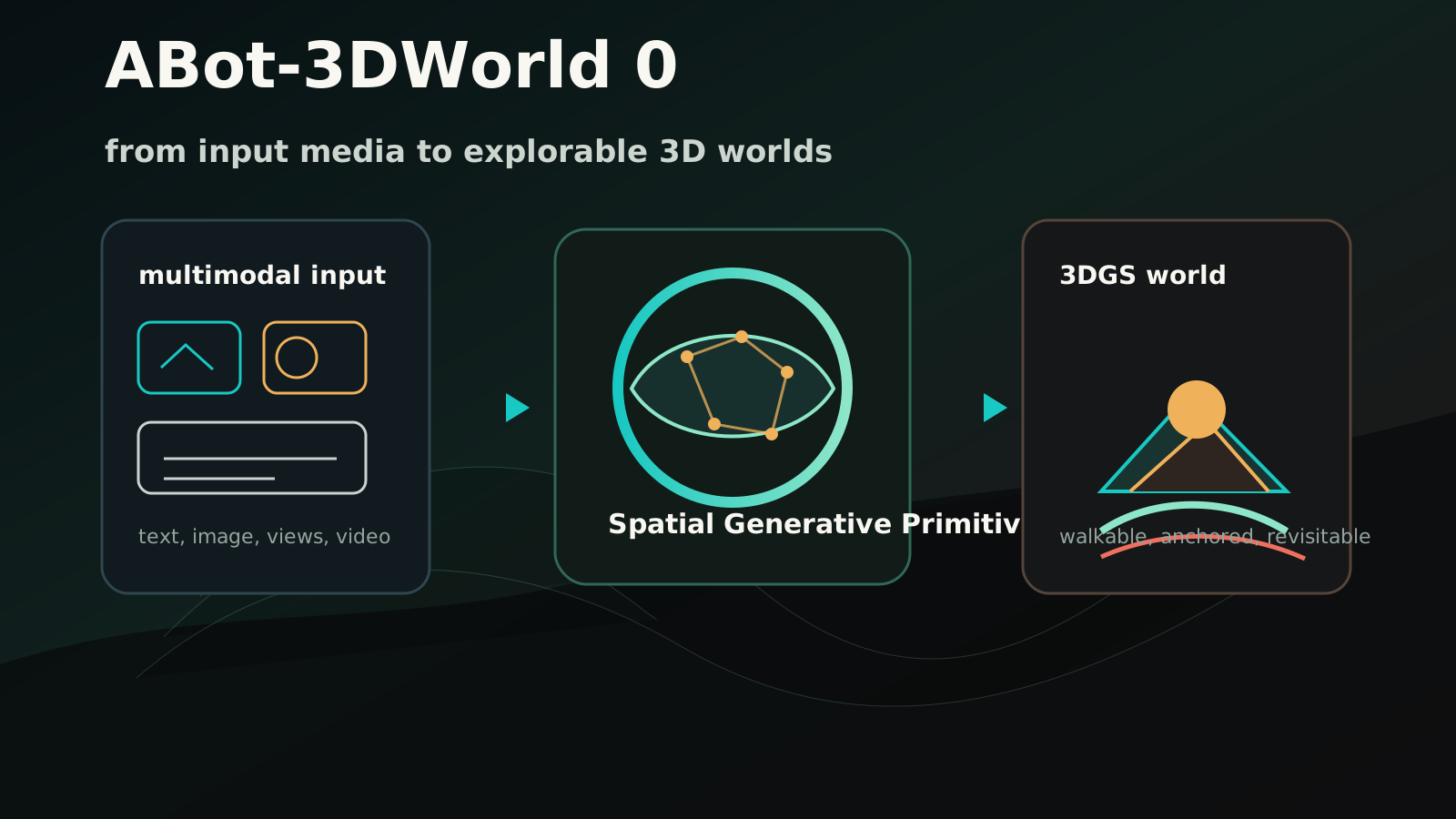
ABot-3DWorld 0 is a world model paper with a simple promise: give it text, a single image, multi-view photos, or a casual video, and it builds a navigable 3D world.
For Story2Board, the interesting part is not the map product around it. The interesting part is the workflow shape. The paper treats video generation as a spatial exploration problem. First it builds a compact world primitive. Then it plans a route through that space. Then it generates panoramic video and reconstructs a 3D Gaussian Splatting world.
That sounds like a different category from storyboarding, but it is not as far away as it looks. A storyboard is also a way of asking: where is the space, where is the camera, what changes from shot to shot, and what should stay stable?
The paper in one sentence
ABot-3DWorld 0 turns every input modality into a Spatial Generative Primitive, explores that primitive with panoramic video, then reconstructs the result as an explorable 3DGS world.
The paper's title is ambitious: A Universal World Model to Explore Any 3D Space. The practical claim is narrower and more useful. It says that one pipeline can cover two different jobs:
| Input regime | What the system tries to do |
|---|---|
| Text or one image | complete an imagined world from a small seed |
| Multi-view photos or video | preserve observed geometry and appearance with less hallucination |
That split matters. Many generative systems treat all inputs as prompts to be re-imagined. ABot-3DWorld does not. When the input has geometric evidence, it tries to keep that evidence. When the input is sparse, it completes the missing world generatively.
That is the right instinct for production tools. A sketch, a location scout video, and a written scene description should not all be crushed into the same prompt box.
The SGP is the real idea
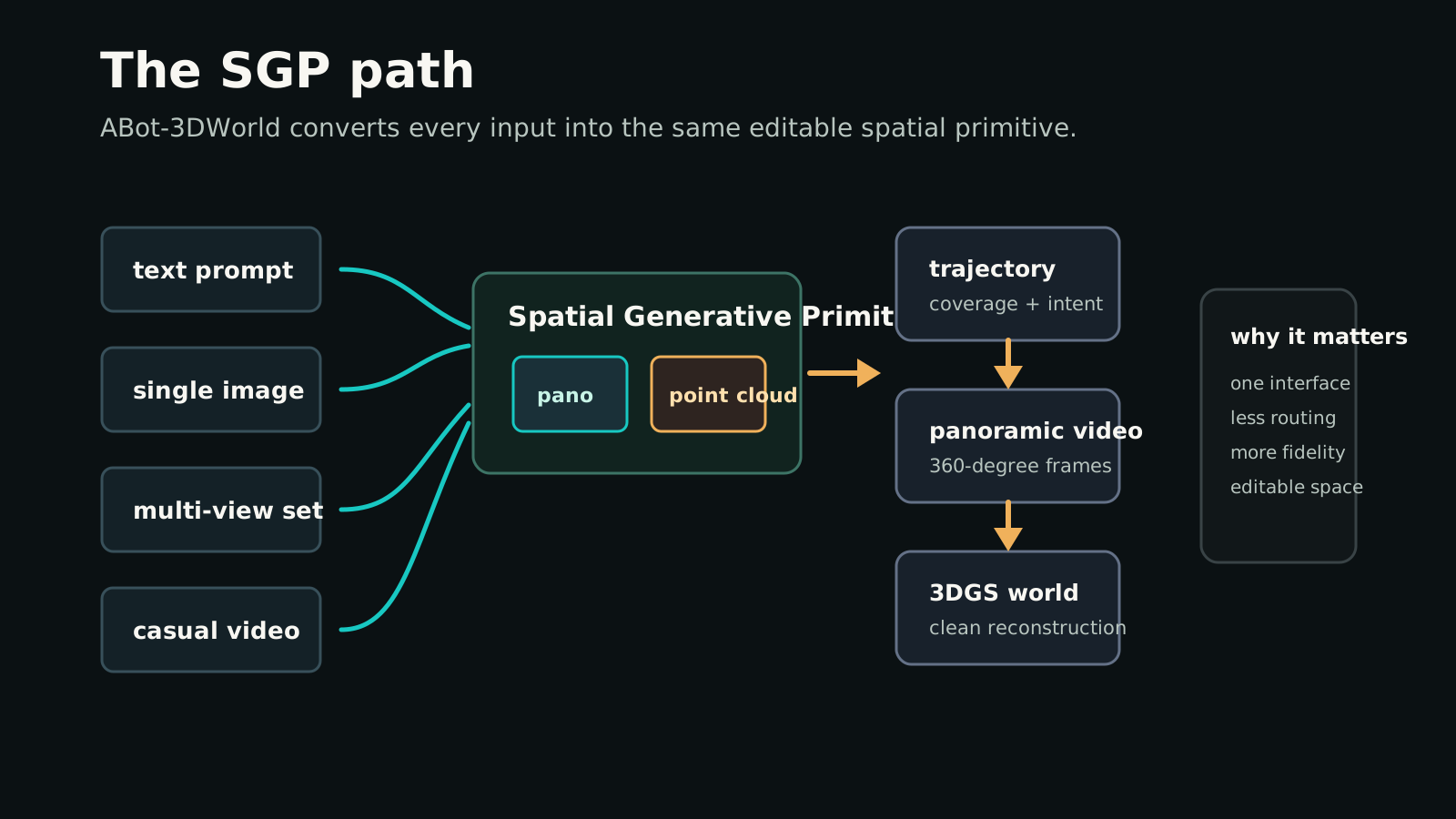
The core representation is called a Spatial Generative Primitive, or SGP. The paper defines it as a compact pair:
| Part | Role |
|---|---|
| High-quality panorama | appearance over a full 360-degree field of view |
| Spatial point cloud | metric structure for navigation and reconstruction |
That pair is not a final render. It is an intermediate spatial memory. A single SGP can represent a room-like area. Multiple SGPs can be registered into a larger world, such as a multi-room interior or a city block.
This is the main product lesson. If a system wants controllable visual planning, it needs an inspectable intermediate representation. Prompts are too soft. Pixels are too late. The SGP sits in the middle: visual enough to preserve appearance, geometric enough to support movement.
For a storyboard system, an SGP-like layer would not need to be full 3DGS on day one. The useful abstraction is smaller:
| Storyboard concept | SGP-like equivalent |
|---|---|
| Location card | persistent spatial anchor |
| Shot direction | camera pose and motion path |
| Prop continuity | stable object positions |
| Blocking | character path through navigable space |
| Revisited scene | same location rendered from a new viewpoint |
The paper is about explorable 3D worlds. The storyboard version is about explorable shot space.
Why panoramic video is the bridge
ABot-3DWorld uses panoramic video as the exploration medium. That is an important choice.
A normal perspective video sees only a narrow field of view. If the system wants to understand a room, it needs many clips or many keyframes. A panoramic frame sees the whole viewing sphere. As the virtual camera translates, each frame contains dense overlap with neighboring frames. That gives the reconstruction engine more coverage and fewer blind spots.
The paper's panoramic video generator is built on a 14B VACE backbone. It is conditioned on point-cloud renderings, camera trajectories, and scene memory. It also uses latent circular padding to avoid the seam problem that appears at the left-right boundary of equirectangular panoramas.
This is not just a model-size story. The stronger idea is that camera movement becomes the data collection strategy. A trajectory is not merely cinematic style. It decides which parts of the scene become observable, which surfaces get parallax, and which details can be reconstructed.
The trajectory planner thinks like a scout
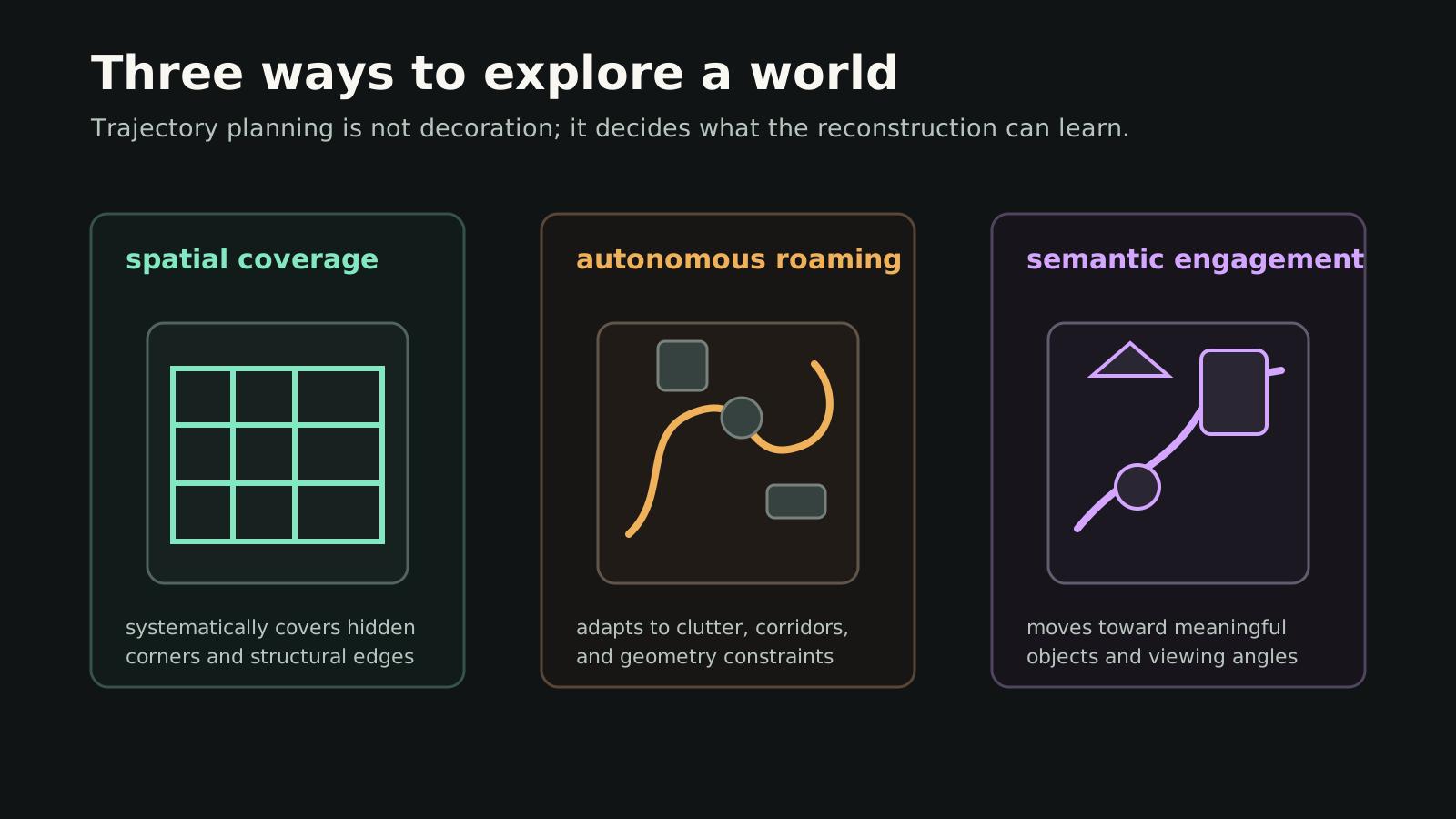
The trajectory planner balances three behaviors:
| Strategy | What it optimizes |
|---|---|
| Spatial coverage | visiting enough viewpoints to cover hidden structure |
| Autonomous roaming | adapting to corridors, clutter, and local geometry |
| Semantic engagement | moving toward meaningful objects and useful viewpoints |
That trio maps cleanly to previsualization. A director does not only choose a beautiful move. They choose a move that reveals information, keeps the subject legible, and respects the physical set.
In Story2Board terms, this is where a co-director should ask better questions:
| Question | Why it matters |
|---|---|
| Can the camera actually move here? | avoids impossible tracking shots |
| What does the movement reveal? | links camera motion to narrative purpose |
| Does the shot need coverage or emphasis? | separates scouting movement from emotional movement |
| What must remain visible? | protects character, prop, and location continuity |
This is why ABot-3DWorld is relevant even if Story2Board is not trying to generate a full 3DGS world for every scene. It shows how shot planning can borrow the language of spatial exploration.
The reconstruction loop is deliberately not one-shot
After generating panoramic video, ABot-3DWorld reconstructs a clean 3DGS world. The pipeline has three broad stages:
| Stage | Purpose |
|---|---|
| Camera recovery and seed point cloud | initialize a coarse 3DGS from the panoramic video |
| FLUX-based repair and refit | sharpen low-resolution panoramic details and reduce inconsistency |
| Wild-scene robustness modules | handle sky, exposure drift, sparse views, reflections, and dynamic clutter |
The repair loop is especially relevant. Panoramic frames spread pixels across 360 degrees, so local crops can lack fine detail. Generated trajectories can also contain photometric or geometric drift. The paper handles this by rendering views from the current 3DGS, repairing them with a FLUX-based refiner, and using those repaired views to refit the Gaussians.
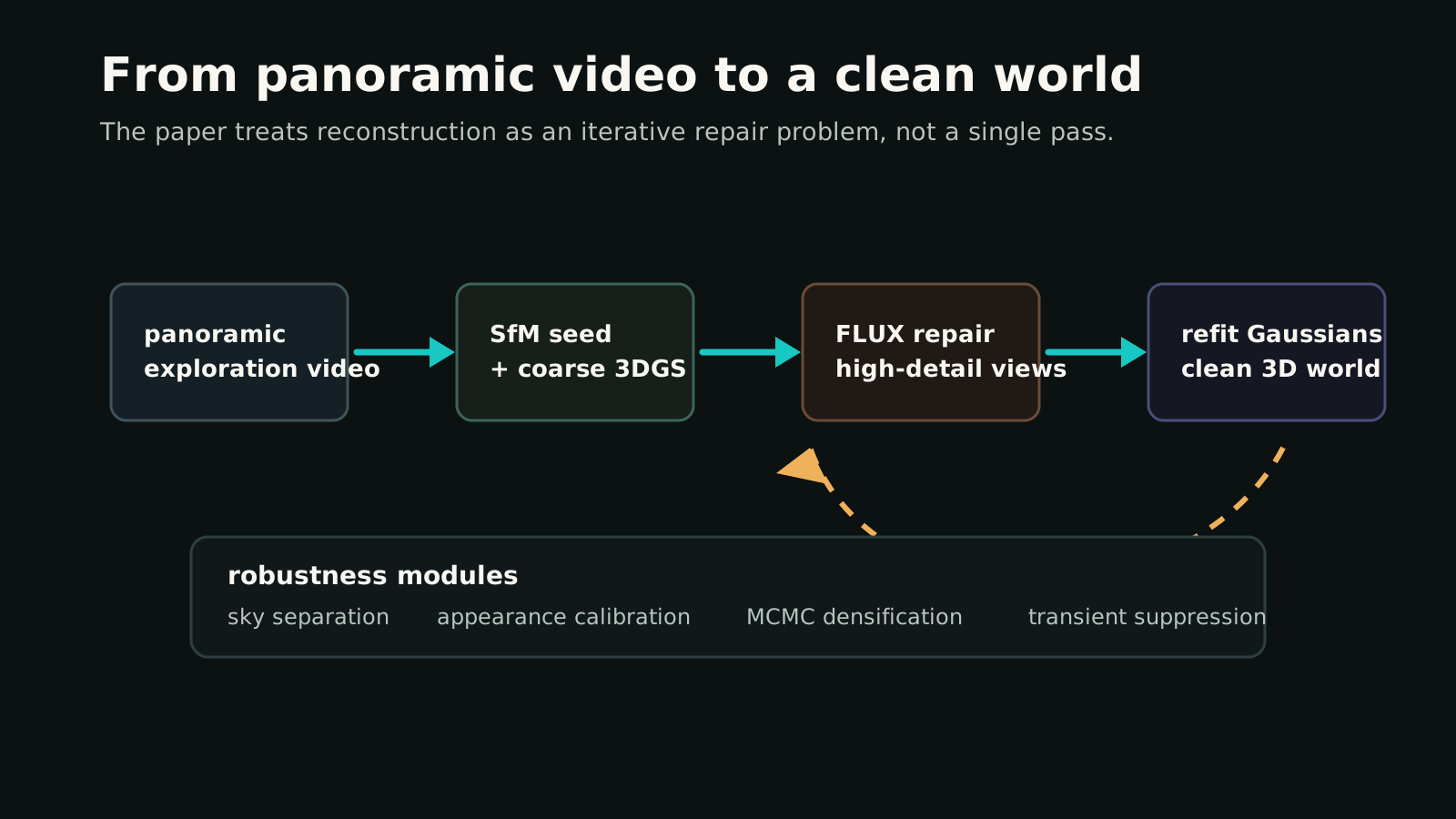
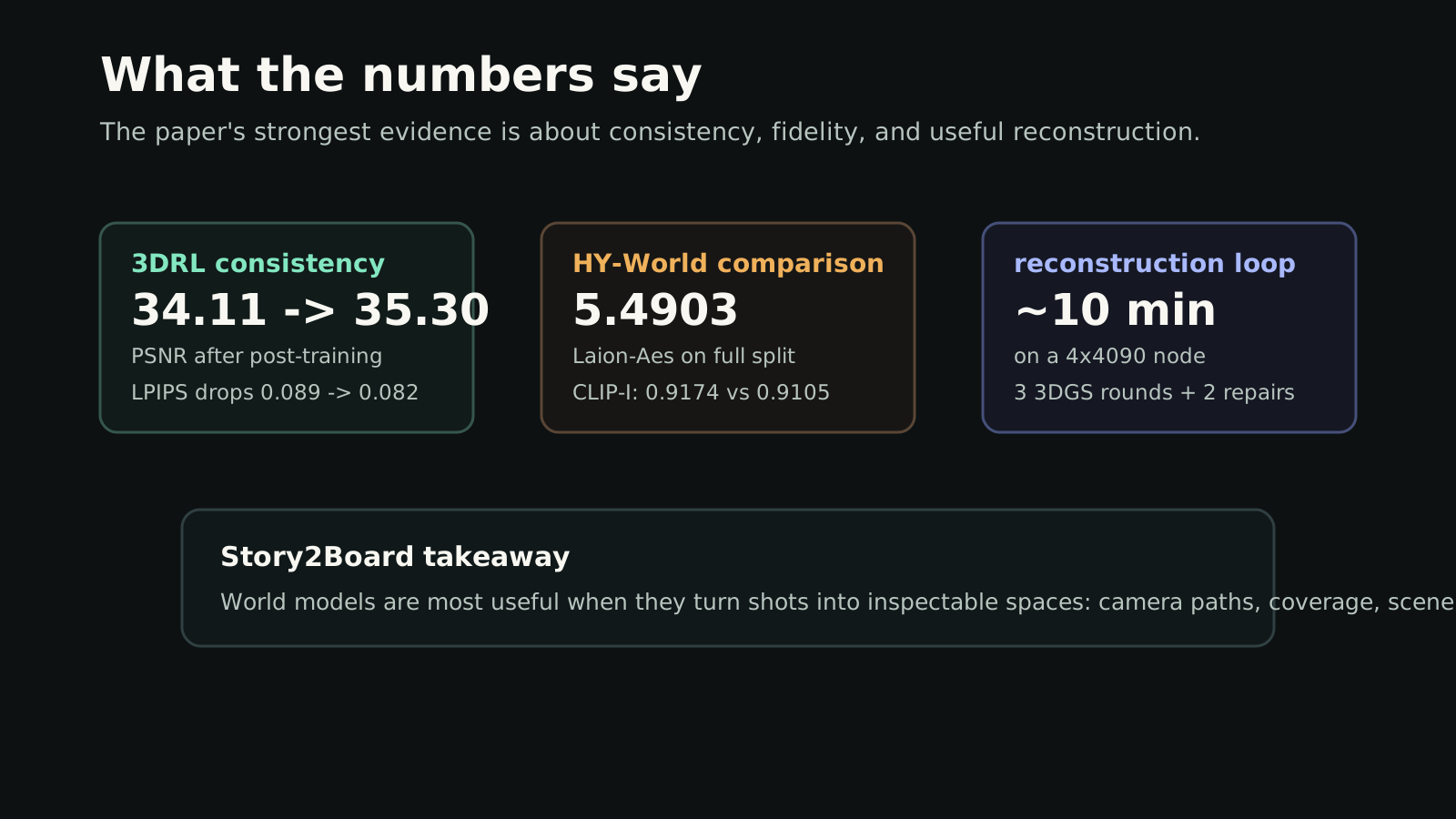
The authors report a practical runtime: on a 4x4090 node, FLUX repair takes about 3 minutes per scene, each 3DGS round takes about 1 minute, and the full pipeline with three 3DGS rounds and two repair rounds finishes in about 10 minutes including overhead.
That is not instant. It is also not fantasy. For a production storyboard tool, this suggests a useful tiering:
| Speed tier | Use case |
|---|---|
| Instant 2D board | ideation and script coverage |
| Lightweight spatial scout | camera feasibility and location continuity |
| Heavier 3D reconstruction | important scenes, location walkthroughs, client review |
Not every shot deserves a 10-minute world build. Some scenes do.
The numbers are useful, but read them carefully
The paper evaluates several pieces separately. The most convincing quantitative section is the 3DRL post-training study. On 100 held-out indoor and outdoor scenes, adding 3D Reinforcement Learning improves both 3D consistency and video quality:
| Metric | Without 3DRL | With 3DRL |
|---|---|---|
| PSNR | 34.11 | 35.30 |
| SSIM | 0.942 | 0.951 |
| LPIPS | 0.089 | 0.082 |
| Depth confidence | 0.396 | 0.412 |
| Aesthetic quality | 46.74 | 47.85 |
| Imaging quality | 43.34 | 44.12 |
The end-to-end comparison against HY-World 2.0 is more mixed, which is useful to say plainly. ABot-3DWorld leads on Laion-Aes and CLIP-I across indoor, outdoor, and full splits. On the full split, Laion-Aes is 5.4903 versus 5.3137, and CLIP-I is 0.9174 versus 0.9105. HY-World 2.0 is slightly ahead on Q-Align, and CLIP-IQA+ is split by category.
That means the paper's advantage is not "wins every metric." The better reading is: ABot-3DWorld improves aesthetic appeal and content fidelity while staying competitive on low-level perceptual quality.
The qualitative comparison with Marble is also important. The paper argues that Marble can hallucinate away evidence from sparse multi-view photos or casual video, while ABot-3DWorld preserves more of the original geometry and photometric evidence through the rich-input SGP path.
For creative tools, that distinction is central. Hallucination is useful when the user asks for imagination. It is destructive when the user gives you a location reference and expects the room to remain the same.
How it relates to World Narrative Model
We recently covered World Narrative Model, which argues that video generation should begin with an editable physical world rather than direct pixel sampling.
ABot-3DWorld shares that direction, but its emphasis is different:
| Paper | Main control object |
|---|---|
| World Narrative Model | scene graph, assets, motion, camera, lighting as an editable production state |
| ABot-3DWorld 0 | panorama plus point cloud as a compact primitive for exploring and reconstructing space |
WNM feels closer to a director console. ABot-3DWorld feels closer to a spatial scouting engine.
Both point away from prompt-only video generation. Both say that the useful layer sits before pixels. One wants a white-box production world. The other wants a universal spatial primitive that can be explored and reconstructed.
What Story2Board should borrow
The immediate lesson is not "turn every storyboard into 3DGS." That would be too heavy and often unnecessary.
The better lesson is to add a spatial checkpoint before expensive rendering:
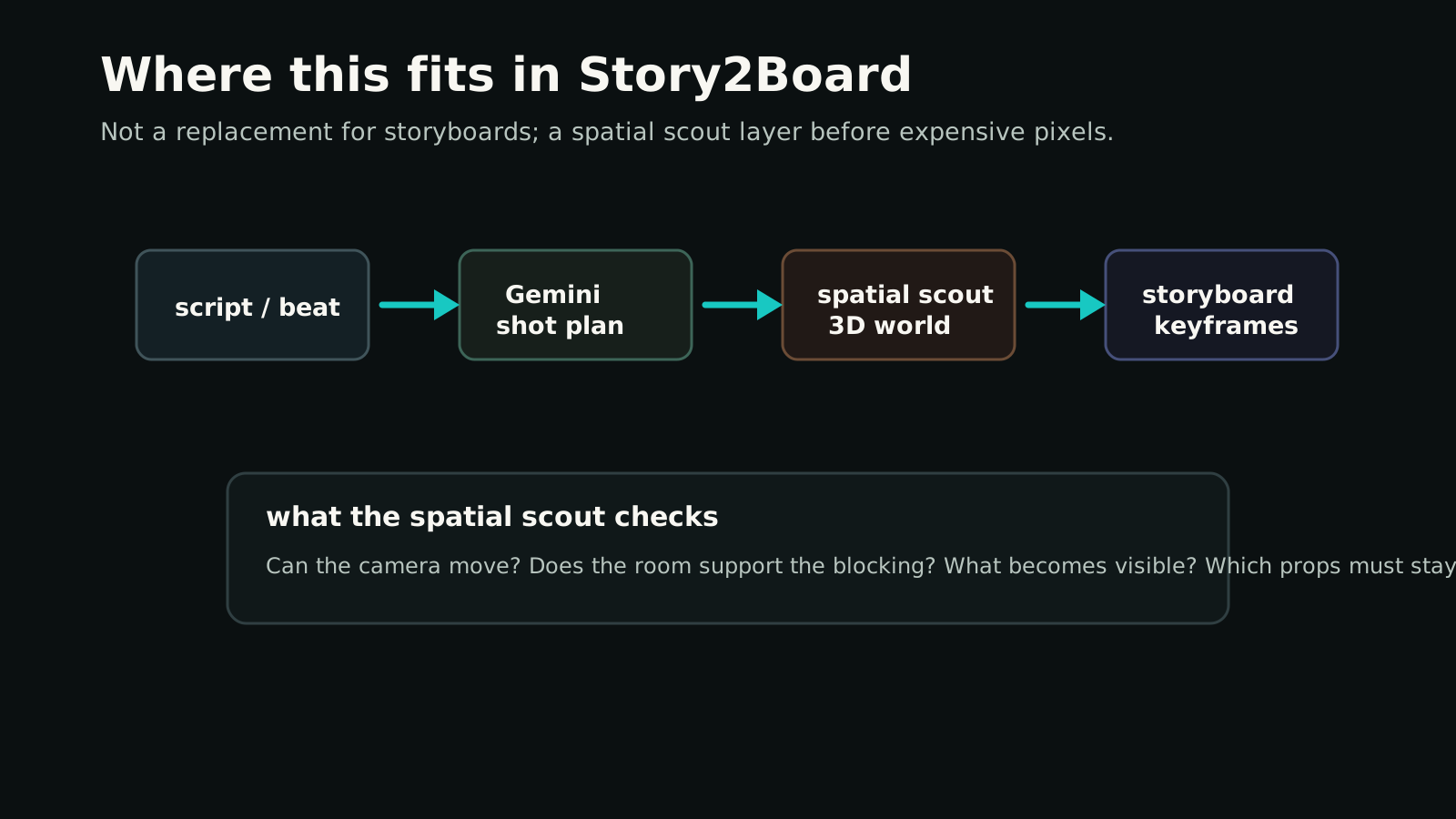
A Story2Board version of this idea could be lightweight:
| Layer | What it stores |
|---|---|
| Location anchor | room layout, landmarks, entrances, major props |
| Camera path | shot start, shot end, movement type, feasibility notes |
| Visibility state | what appears, disappears, or must stay in frame |
| Continuity memory | which location details must persist across panels |
| Render instruction | what the image model needs after planning is settled |
That connects directly to our CANVAS breakdown, where continuity is treated as a story-state problem rather than a pure image problem. It also connects to our camera movement guide: a camera move is not only a visual style label; it is a spatial commitment.
ABot-3DWorld gives us stronger language for that commitment. The camera is exploring a world, not merely decorating a frame.
Where the paper is still limited
The system is impressive, but its limits matter.
First, it is expensive enough that it belongs in a tiered workflow. A 10-minute reconstruction loop is useful for selected scenes, not every thumbnail pass.
Second, the world is mostly static. The paper includes physical attributes such as occupancy and collision meshes, plus portal-style effects, but richer interaction is still future work. Storyboards often depend on human-object contact, prop exchange, hand detail, and staged action. Those remain hard.
Third, the map-native angle is powerful but product-specific. Anchoring worlds to geographic points of interest makes sense for AMAP. Story2Board would use a different anchor: screenplay location, scene continuity, shot purpose, and production design reference.
Fourth, evaluation is still fragmented. Metrics like Q-Align, CLIP-IQA+, Laion-Aes, and CLIP-I tell part of the story, but they do not directly measure whether a scene is useful for a director. For storyboard tools, we need different tests: camera feasibility, continuity preservation, editability, shot intent alignment, and retry reduction.
The product lesson
ABot-3DWorld is useful because it reframes generation as spatial work.
The creator does not only ask for a pretty image. They ask for a place that can be revisited, a camera that can move through it, and a set of visual facts that remain stable when the next shot begins.
That is exactly where storyboard systems are heading. The first generation of AI storyboard tools turned text into panels. The next generation needs to maintain locations, camera paths, prop states, and shot intent across a sequence.
ABot-3DWorld suggests one way to get there: build a compact spatial memory first, explore it deliberately, then render from a world that has geometry.
For Story2Board, the near-term version is not a full universal world model. It is a practical spatial scout layer between script understanding and final pixels. That layer can make the co-director better at asking what every director already asks:
Where are we standing? What can the camera see? What changes when we move?
References
Sun, M., Tang, L., Liu, Y., Yan, X., Li, Z., Zhang, Y., Yu, F., Ge, Z., Liu, Y., Zhang, J., Zhang, Y., Zhang, J., Liu, Z., Sun, Z., Ouyang, T., Chen, W., Yang, S., Fan, N., Sun, G., Li, H., Zhou, Z., Li, Y., Peng, Y., Du, M., Liu, Y., Shi, H., Gong, C., Yu, C., Jia, C., Liu, Y., Zeng, S., Lai, J., Zhang, H., Guo, N., Chen, B., Xu, M., & Pan, H. (2026). ABot-3DWorld 0: A Universal World Model to Explore Any 3D Space. arXiv preprint arXiv:2607.11673. https://arxiv.org/abs/2607.11673