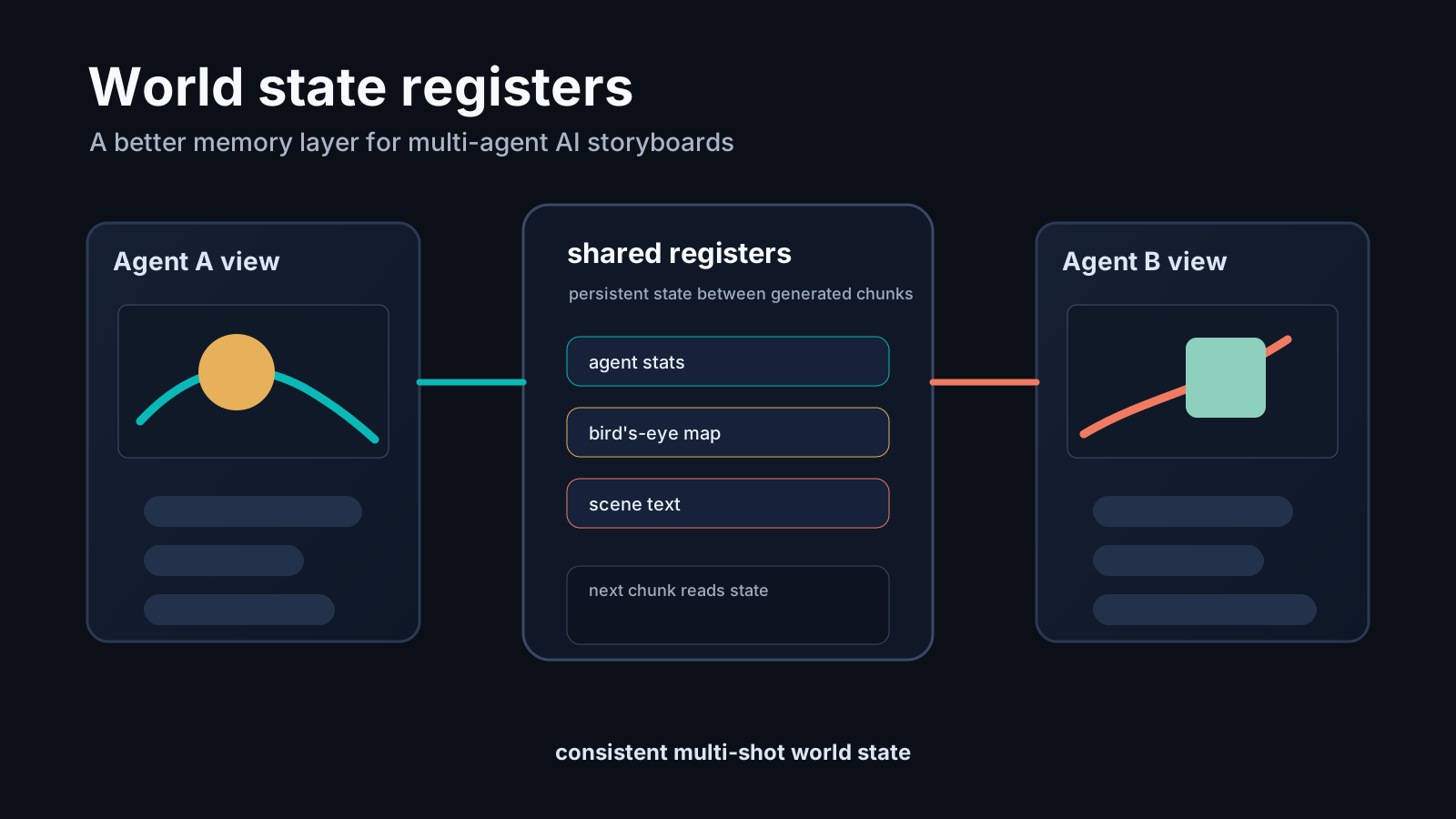
WorldWeaver is useful for AI storyboarding because it says the quiet part out loud: a generated frame is not a world state. If two agents stand in the same Minecraft world, each first-person video stream only sees part of the truth. The model still needs one shared memory of where both agents are, what changed, and what should carry into the next generated chunk.
Mo et al. (2026) call that memory a world state register. The idea is technical, but the product lesson is plain. If a storyboard system wants consistent characters, locations, props, and camera logic, it needs a state layer that lives outside the pixels.
What the paper does
WorldWeaver is a streaming multi-agent autoregressive diffusion model. It starts from the Solaris multi-agent Minecraft setting: two players, synchronized first-person video streams, action inputs, and a shared simulated world.
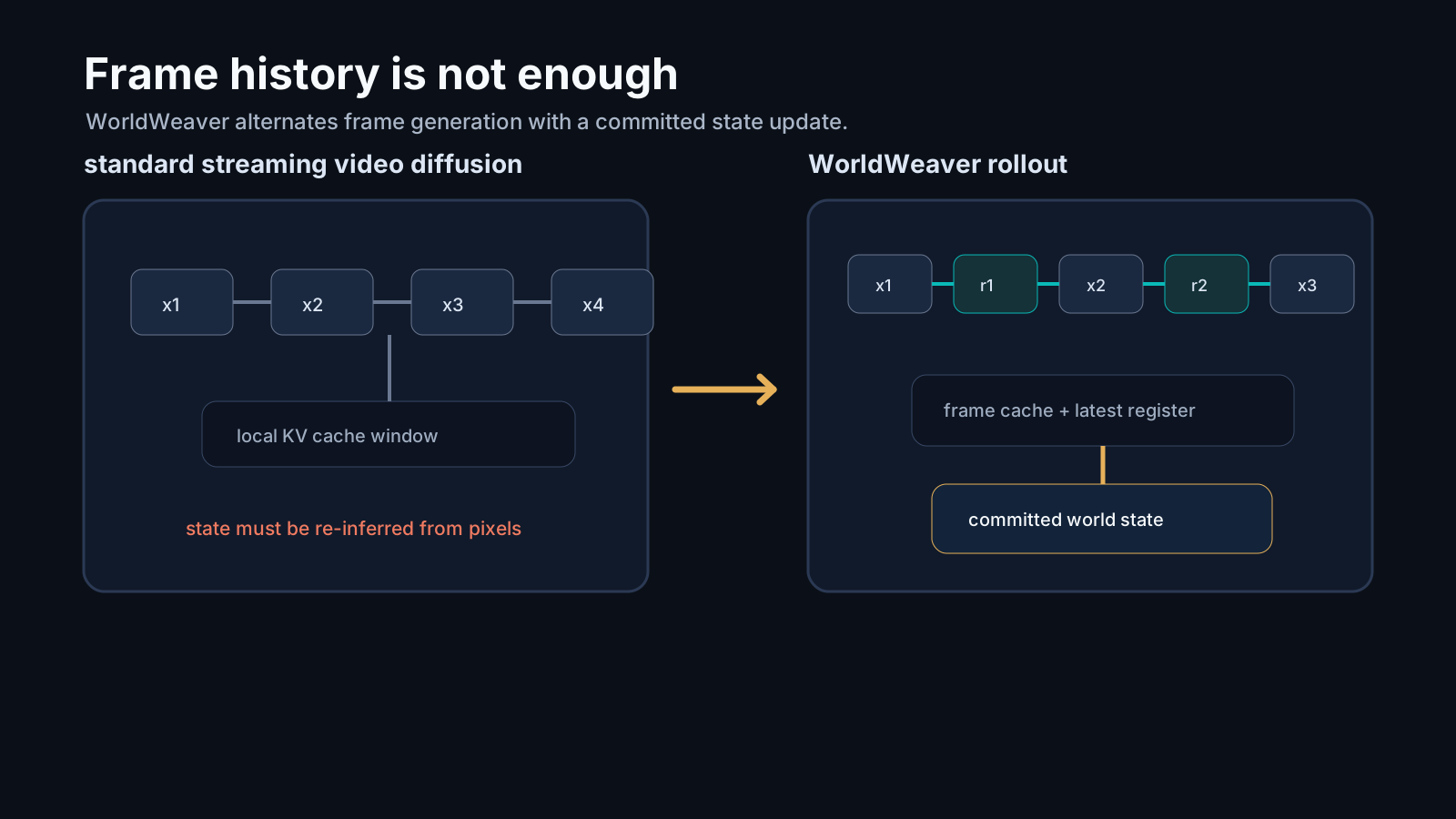
The baseline approach carries forward recent frames through a local KV cache. That helps temporal continuity, but it doesn't give the model a durable shared state. A frame cache is biased toward what was recently visible. It may not remember what the other agent saw, what happened off-camera, or what the global layout says should be true.
WorldWeaver adds a set of learnable register tokens to the rollout. After each generated chunk, the model updates those registers. The next chunk reads both the frame cache and the latest register state.
The registers are trained to hold three kinds of world information:
| Register supervision | What it stores | Why it matters |
|---|---|---|
| Agent stats | position, velocity, orientation | keeps individual motion and facing direction verifiable |
| Bird's-eye view | global layout and relative placement | gives the model an allocentric map, not just egocentric views |
| Scene text | language description of the current state | keeps high-level semantic changes readable |
The prediction heads are only used during training. At inference time, the model keeps the registers but discards the supervision heads. That matters because the paper is not adding a visible text planner beside the model; it's trying to make the hidden state inside the generator more grounded.
Why frame memory fails
We see the same pattern in storyboards, just with still panels instead of Minecraft videos.
A storyboard panel is an observation. It is not the whole scene. It may show a close-up of a key, but not the kitchen layout. It may show a character's face, but not where the other character is standing. It may show a door closing, but not whether the stolen prop is now gone from the table.
If the next panel is generated from the previous image plus a prompt, the model can imitate surface appearance while missing state. The face may stay close enough, but the room flips. The prop returns. The eyeline points nowhere.
This is why WorldWeaver lands near our existing reading of CANVAS and GEST-Engine. CANVAS argues that characters, locations, and object state need explicit continuity tracking. GEST-Engine argues that video should trace back to event state. WorldWeaver makes a similar argument inside streaming diffusion: the rollout needs a persistent state pathway.
Not a longer prompt. A state pathway.
The rollout in plain English
WorldWeaver trains in three stages.
First, it adapts a video diffusion model to synchronized two-agent clips with bidirectional attention. This teacher sees the full clip and learns the shared scene structure.
Second, it turns the model into a causal streaming student. The student sees only past context, generates the next frame, and updates the world state registers. At this stage the registers receive explicit supervision from agent stats, bird's-eye-view features, and scene text.
Third, it uses self-forcing. The model rolls out on its own generated history rather than only ground-truth frames. That exposes both frame drift and register drift during training. The paper notes that DMD-style self-forcing alone was not enough; register supervision still mattered for stabilizing long-horizon rollout.
The architecture also changes. WorldWeaver uses a Mixture-of-Transformers design so frame tokens and register tokens can use separate weights while still attending together. The paper's explanation is sensible: pixels and state are doing different jobs. Asking the same dense transformer path to render frames and maintain a semantic world register can create conflict.
The numbers
The experiments use about 126 hours of synchronized two-player Minecraft recordings. Evaluation is on the Solaris test split. The paper reports VLM accuracy and FID across five categories: Movement, Grounding, Memory, Building, and Consistency. It also reports an auxiliary WorldScore, which combines VLM accuracy and FID. The authors warn that WorldScore is unbounded and scale-sensitive, so it should be read as a ranking aid rather than a universal metric.
Still, the pattern is clear.
| Method | Movement VLM | Grounding VLM | Building VLM | Consistency VLM | WorldScore |
|---|---|---|---|---|---|
| Frame concat | 77.1 | 53.1 | 0.0 | 49.5 | 49.1 |
| Solaris | 79.7 | 81.3 | 9.4 | 57.8 | 81.0 |
| WorldWeaver | 82.8 | 93.8 | 28.1 | 76.6 | 105.1 |
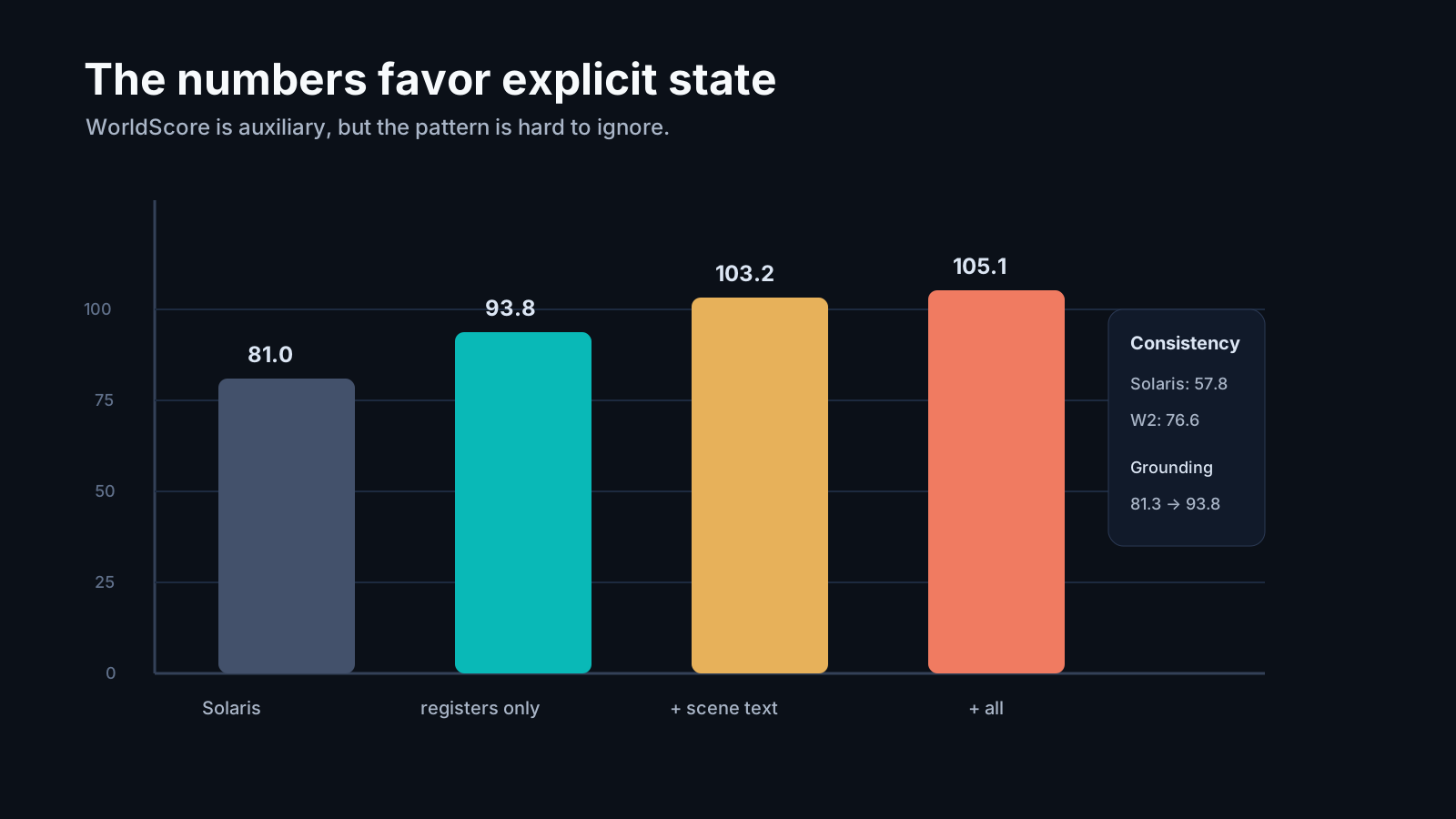
The biggest wins are not cosmetic. Grounding rises from 81.3 to 93.8. Building rises from 9.4 to 28.1. Consistency rises from 57.8 to 76.6. Those are the categories where a hidden state should matter.
The ablations are more interesting than the main table:
| Variant | WorldScore | What changed |
|---|---|---|
| Solaris baseline | 81.0 | no world state registers |
| Registers only | 93.8 | persistent register slots, no explicit targets |
| + Scene text | 103.2 | semantic grounding helps most among single signals |
| + All supervision | 105.1 | agent stats, bird's-eye view, and scene text together |
Registers alone help. That suggests the model benefits from having a dedicated state slot even before the state is fully supervised. But the best result comes when the registers are told what to encode.
That is the lesson I would keep.
What maps to Story2Board
Story2Board doesn't need to copy a Minecraft simulator. We don't have a ground-truth bird's-eye camera for a drama scene in a kitchen. We don't get exact velocity vectors for every character. And most storyboard projects start from script text, reference images, and director notes rather than a game engine.
But the mapping is still strong.
| WorldWeaver concept | Story2Board equivalent |
|---|---|
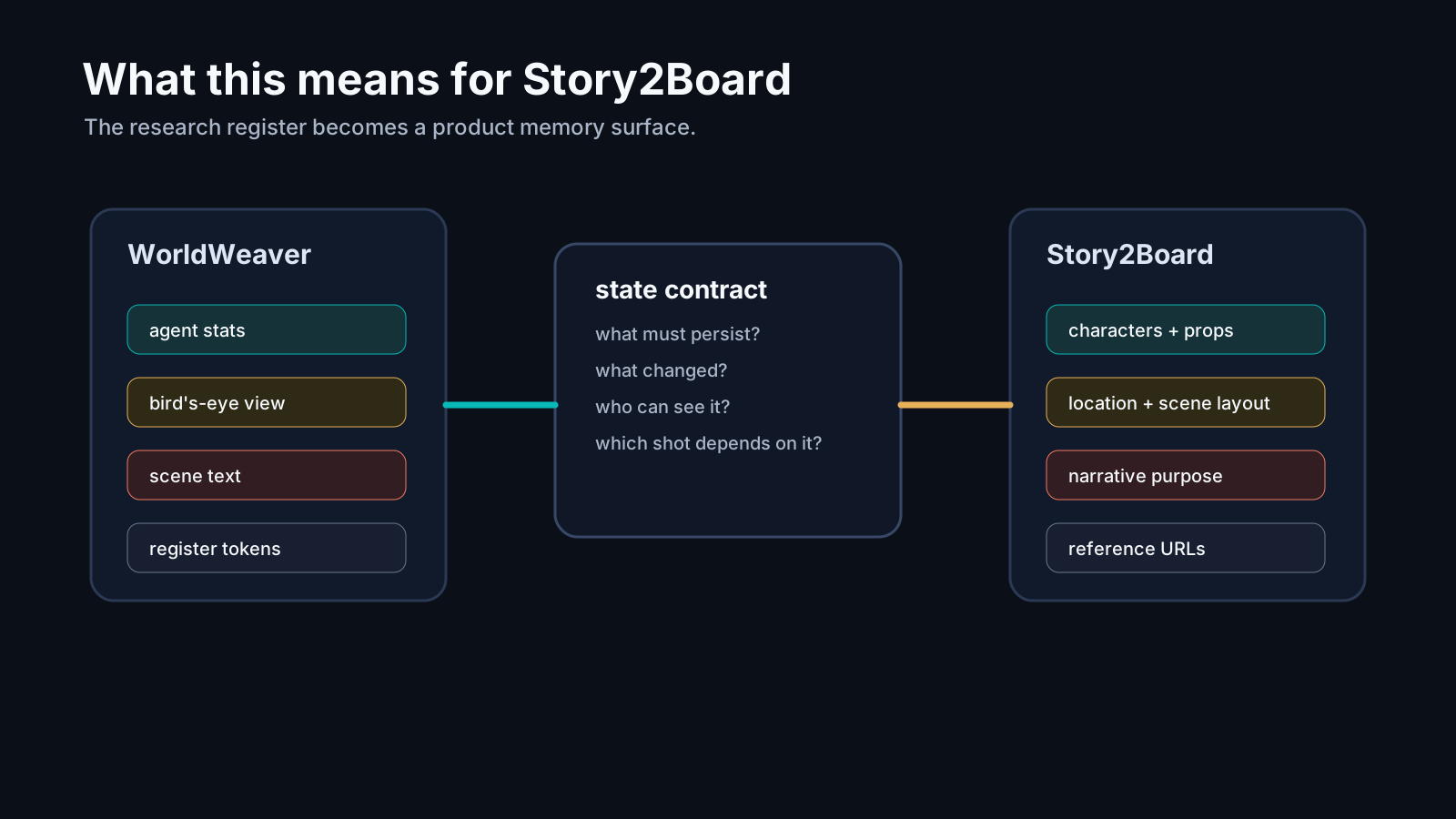
| Agent stats | character position, facing, action, eyeline, emotional state |
| Bird's-eye view | location layout, scene geography, camera axis, blocking map |
| Scene text | narrative purpose, beat summary, dialogue context, sound cue |
| Register token | editable shot state and project memory |
| Register update | revise shot fields after each generated panel |
This is close to how our shot model already wants to work. A shot is not just an image URL. It has action, shot size, angle, camera movement, equipment, focal length, lighting, duration, emotional tone, narrative purpose, dialogue, sound design, notes, characters, props, and reference URLs.
WorldWeaver gives a research vocabulary for why those fields matter. They are not paperwork. They are the state that pixels cannot reliably preserve by themselves.
A better storyboard memory contract
If we translate the paper into product language, every shot should answer four state questions:
| Question | Example |
|---|---|
| What must persist? | Maya wears the red raincoat; the kitchen window is behind her left shoulder |
| What changed? | the key moved from the table to her hand |
| Who can see it? | Maya sees the key; Jesse is off-screen and does not |
| Which later shot depends on it? | shot 07 must show Jesse reacting before he sees the key |
That last question is usually missing. Storyboard tools often track what appears now. They rarely track what a later panel will depend on. World state registers are a reminder that state is useful because it conditions the next chunk.
For an AI storyboard, that means the memory layer should be forward-looking. A prop state is not just a note about panel 03. It is a constraint on panel 04, panel 08, and any return to the same room.
Where the paper is limited
The limitation section is short but important. The authors say their main improvement comes from additional state supervision, and real-world state is much more complex and not directly available.
That's the hard part. Minecraft gives you position, velocity, orientation, action inputs, overhead views, and synchronized streams. A live-action screenplay does not. A creator may write "she feels watched" and never specify where the watcher is. A reference image may imply a room layout but not define it. A prop may matter emotionally before it matters visually.
So the direct research path is not "add registers to a storyboard product." The product path is more modest:
- keep state fields editable;
- preserve reference images and previous generations;
- ask the director when state is ambiguous;
- separate visible image prompts from hidden continuity notes;
- evaluate generated panels against the state contract.
Honestly, that is more useful than pretending the model can infer everything.
Why this belongs with CANVAS, GEST, and EvolvingWorld
Several recent papers are converging on the same design direction:
| Paper | State layer |
|---|---|
| CANVAS | character, location, and object continuity tables |
| GEST-Engine | event graph with actor/object/location/time state |
| EvolvingWorld | open-schema character and world profiles |
| WorldWeaver | hidden world state registers inside streaming diffusion |
They operate at different layers. CANVAS works at the storyboard-image pipeline level. GEST uses simulation and annotation. EvolvingWorld works with literary world state. WorldWeaver works inside a video diffusion rollout.
The shared bet is the same: generated media needs state that survives from one moment to the next.
What we would build from this
For Story2Board, the near-term version is not a neural register. It is a structured register the creator can inspect.
The co-director can maintain:
- a character state row for each recurring character;
- a location state row for each reusable space;
- a prop state row for important objects;
- a shot state row for action, camera, sound, and narrative purpose;
- a reference row for images that should condition future panels.
Then each generated panel can be reviewed against that state. Did the character drift? Did the room flip? Did the prop reset? Did the camera break the dialogue axis?
That is less glamorous than a hidden register bank. It is also shippable.
And later, if storyboard models become more like streaming world models, those explicit fields become training targets. That is the bridge WorldWeaver points toward: a storyboard tool can collect state in human-readable form today, and future generators can learn to carry it as internal state tomorrow.
Bottom line
WorldWeaver is not a storyboard paper. It is a multi-agent video diffusion paper in Minecraft. But it is directly relevant because it attacks the same failure mode that makes AI storyboards unreliable: the model sees frames, but it forgets the world.
The useful lesson is not only that registers improve a benchmark. It is that consistency improves when the system has a dedicated place to store state and explicit signals that teach that state what to remember.
For AI storyboards, that means every panel should be more than a prompt and an image. It should be a state update.
References
Mo, S., Li, Y., Leng, Z., Singh, K. K., & Zhou, B. (2026). Streaming Multi-Agent Autoregressive Diffusion Model with World State Registers. arXiv preprint arXiv:2607.21594. https://arxiv.org/abs/2607.21594
Savva, G., Michel, O., Lu, D., Waiwitlikhit, S., Meehan, T., Mishra, D., Poddar, S., Lu, J., & Xie, S. (2026). Solaris: Building a Multiplayer Video World Model in Minecraft. arXiv preprint arXiv:2602.22208.
All diagrams were created by the Story2Board team for this analysis.